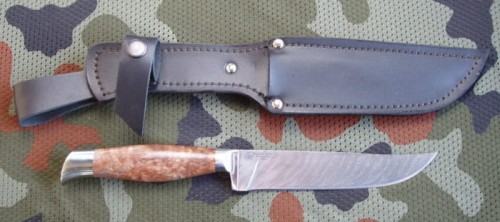
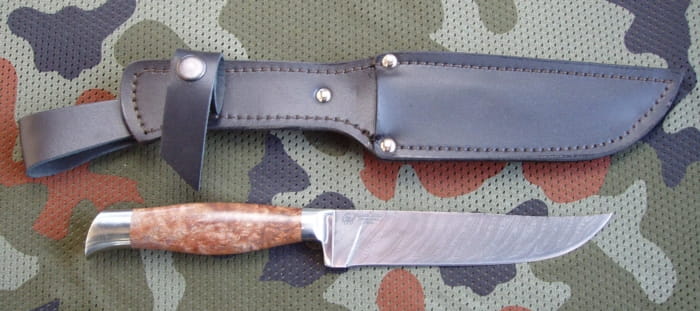
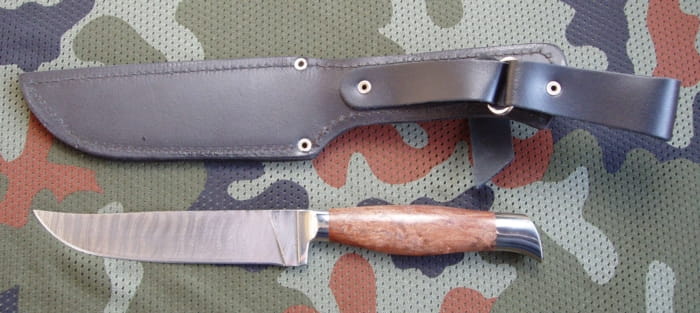
Pchak (from the Uzbek wordPichoq– knife)is a traditional knife of Uzbeks and Uyghurs, widespread with minor differences in details throughout Central Asia. Pchaks traditionally have a single-edged blade with a full flat grind, set in a narrow handle with a round cross-section. A narrow tang extends from the blade at the level of the spine. These are utility knives, for kitchen work, although among the Uyghurs, the pchak was a man's attribute, so it must also have been used as a weapon. Pchaks were made from various materials; for the wealthy, they could be high-quality steels with richly decorated handles, but such specimens were rare. Bułat and Damascus steel were used more for sabres, and mass-produced pchaks were made of low-hardness carbon steels. Today, Uzbek pchaks made of 90% industrial tool steel ШХ15 (Polish equivalent LH15) are widely available in Russia. However, the growing fashion for exotic blades unusual for Europe (Yakut knives, Nepali kukris, karambits) means that pchaks are appearing on the market, handcrafted in the European part of the former USSR, in regions where blacksmithing traditions have been preserved.
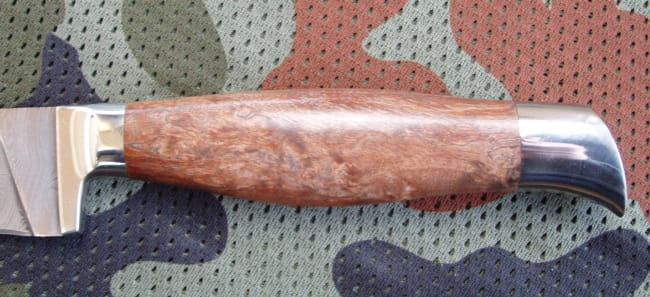
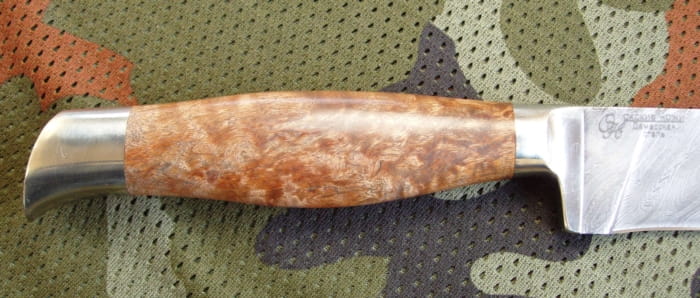
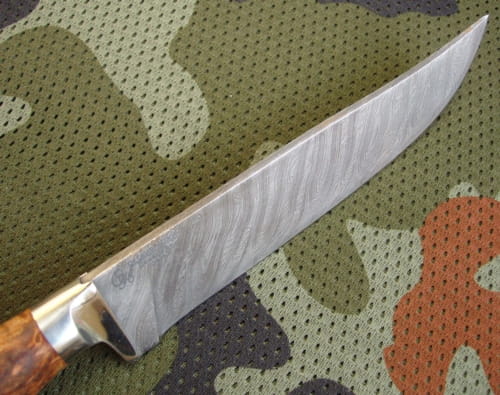
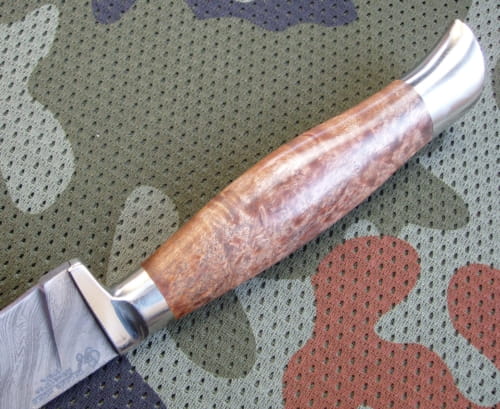
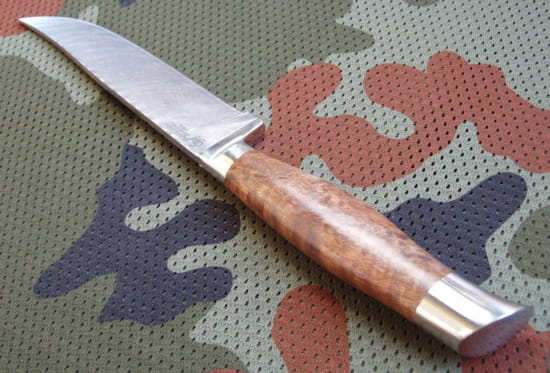
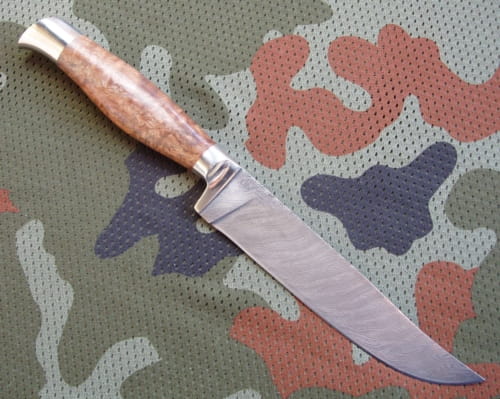
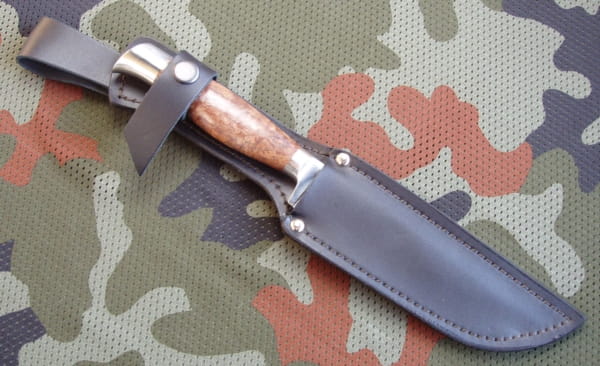
This pchak is a so-called Stary Bukharski pchak (or kord), with proportions of the blade typical for this subtype and a slightly higher elevation of the tip above the spine line. The blade is made of very good quality forged Damascus steel, a bolster (called giulband) typical for pchaks made of nickel silver, and the handle is made of stabilized Karelian birch – one of the more expensive types of stabilized wood. Full flat grind. A manufacturer's monogram and inscription are engraved on the blade under the handle:"ОКСКИЕ НОЖИ ДАМАССКАЯ СТАЛЬ",but the whole is poorly visible against the background of the Damascus pattern. Leather sheath.
Total length: 276 mm
Blade length: 147 mm
Blade width (max.): 30 mm
Blade thickness (max.): 3.7 mm
Manufacturer: Okskije nozhi company, Pavlovo, Russian Federation

 Briefly about pchaks (or pichaks, or pichoqs)