

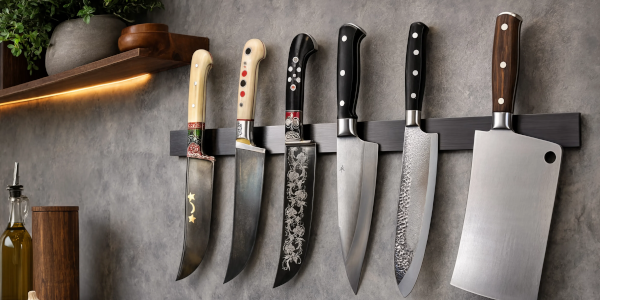
What explains popularity of these knives?
The pichak is a traditional knife used by Uzbeks and Uyghurs. With minor variations in detail, it is widespread across Central Asia. There are various subtypes of pichaks, and specialists can debate for hours over the differences and similarities between Fergana and Bukhara styles, or their connection to Tajik kards. However, to an outsider, all these knives look similar, as if they all branched out from a single root. That is likely the case, given how many features they share.The fact that their design has changed very little over the centuries is nothing unusual - that is simply what happens with successful designs. The fact that pchaks retained their form throughout the Soviet era is not particularly extraordinary either. However, the current popularity of these knives - not only within Central Asian countries but also in Russia, where they have no roots in the local culture – this might come as a surprise.The knife market in modern Russia is truly vast, both in terms of industrial production and craft knives. In previous posts, I mentioned that these are generally very decent quality knives at attractive prices. The fact that pchaks find buyers in this market may be surprising. This is especially true when you consider that small-scale makers from Uzbekistan or Tajikistan lag far behind Russian knifemakers regarding used materials and production facilities.Most of them received no formal training, not even at a vocational school level. They learned the craft from their fathers. I once purchased a batch of knives from one of these artisans and questioned him about the details of specific models - what steel grade they were made of, their hardness, and what heat-treatment methods he used for different materials. The guy seemed to trip over his own words. At some point, he probably realized that I was beginning to doubt his expertise. Then he told me something like this: "Look, we didn't graduate from any special schools, there are no metallurgical engineers among us, and hardly anyone owns a hardness tester. We make knives out of whatever is usable and easily available." And indeed, while in Russia there are many dealers offering top-quality imported steels from renowned global manufacturers (with the post-2022 sanction regimes not having thinned out their selection much), makers from the former Soviet republics still use terms like "valve," "rail," or "leaf spring" instead of steel grade names. I will never forget an elderly blacksmith who, when asked what steel the blade he was forging was made of, replied "file" ("напильник" – as the conversation was, of course, conducted in Russian). Well, I had thought, maybe he means R12, but that material is truly difficult to heat-treat, and you cannot just do it in a bucket of water. When asked to clarify if it was R12, the old man shrugged and repeated "file" and pointed to a battered basin in the corner of the workshop filled with handleless files and even broken pieces of them.
There is one significant advantage when craftsmen use salvaged or recycled metal as raw material: their blades must be forged. In a knife factory, blades are stamped out from rolled steel sheets using industrial presses. It is simply impossible to stamp a blade out of a piece of rail track, a chainsaw chain, or an engine valve. All of these must be heated and forged into shape.
Both in the past and today, top-quality steel was not used to make pchaks - high-end bulat and Damascus steel went into weapons, while the pchak was primarily a kitchen knife that had to be affordable for everyone. Of course, you can find pchaks made of powder metallurgy steels, Damascus imported from Russia, or various fancy laminates, but this production is mostly intended for the external market. Even stainless steels became more widespread only relatively recently. At the end of the 20th century, a pchak meant a knife made of mass-produced, high-quality yet cheap (an oxymoron typical of the USSR's planned economy) corrosive carbon bearing steel, such as the Russian ShKh15 (ШХ15). The acronym stands for: "Sh">arikopodshipnikovaya"Khrom (chromium) 1.5%. The carbon content ranges from 0.95% to 1.05%. According to the AISI standard, its equivalent is 52100 steel, and in the German DIN system, it is 100Cr6 steel. As I mentioned, this steel is highly prone to corrosion - it is best not to even breathe on it - but let's be honest, if someone manages to neglect a knife so badly that it develops pitting, in my opinion, he does not deserve to own one at all.
So, why do people buy something like this today, when alternatives made of better materials are readily available?
If we put aside factors like a taste for the exotic or the cult of non-mass-produced, handmade products, there is only one answer: the pchak is a knife that works exceptionally well in the kitchen. In other words: pchaks cut well. And they cut well because they have excellent geometry. Thin, fairly wide blades with a full flat grind made of carbon steel always get the job done, and they don't even need to be super-hardened for it. The cutting aggression of a pchak is a product of its geometry rather than the material used and its heat treatment. A hardness of 54-55 HRC is perfectly adequate for kitchen use, and you don't even need a whetstone to touch up such a blade - you simply flip over a saucer or a mug to expose the unglazed rim, give it a few passes, and you're good to go. Let me emphasize once again: we are talking about kitchen knives - weapons or bushcraft are a completely different story. I highly recommend it to anyone who wants something unique on their magnetic knife strip that will instantly catch guests' eyes. And the fact that they cannot be washed in a dishwasher (because they absolutely can't) - well, aluminum mess kits are also more practical than plates as they don't break.