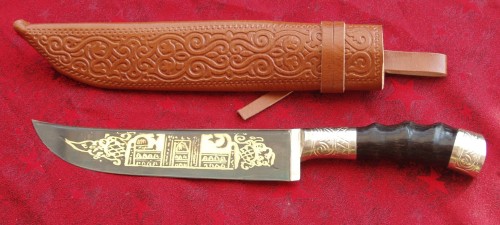
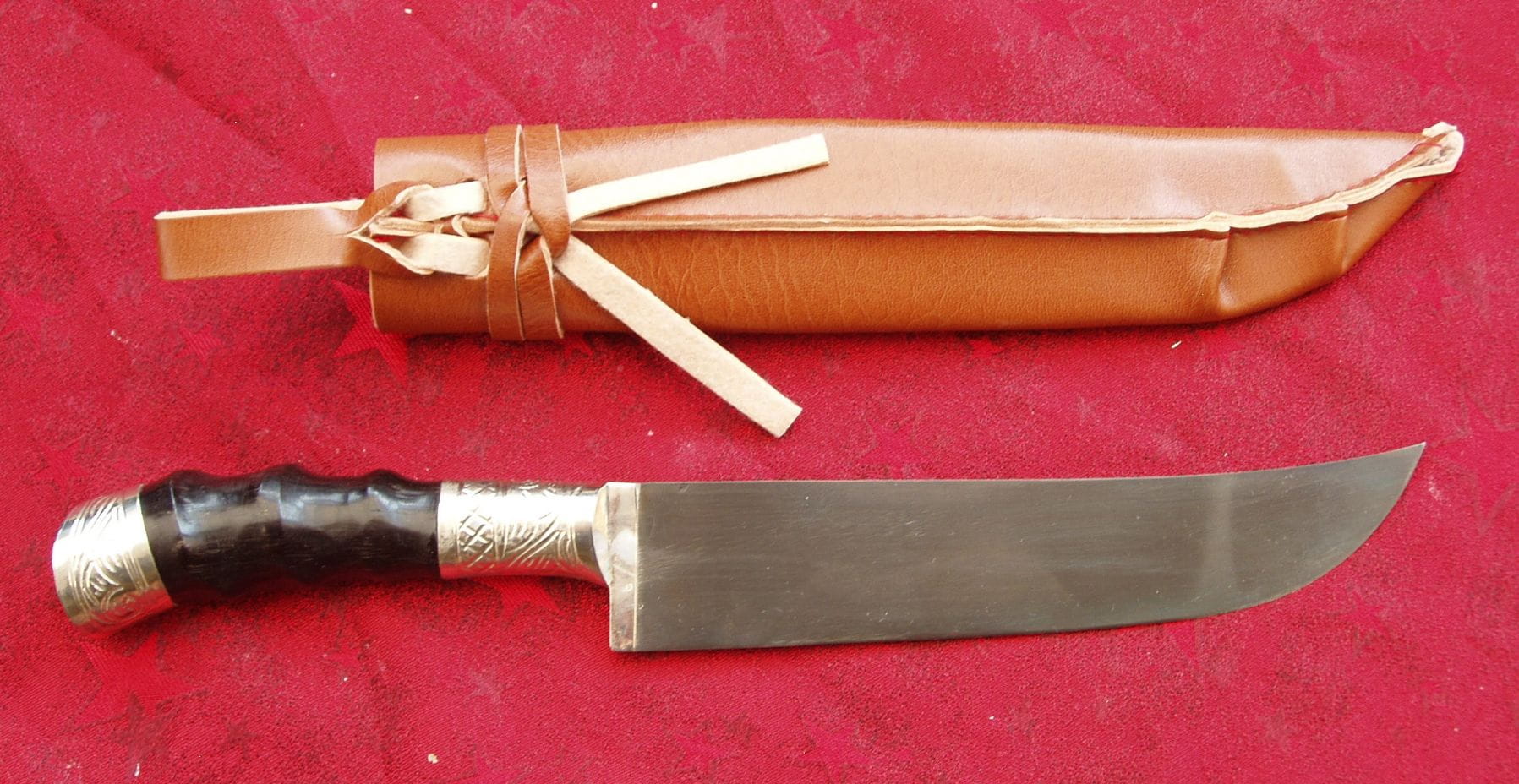
Pchak (from the Uzbek wordPichoq– knife) is a traditional knife of the Uzbeks and Uyghurs, widespread with minor differences in detail throughout Central Asia. Pchaks traditionally have a single-edged blade with a full flat grind set in a (mostly) narrow handle with a round cross-section. A narrow tang extends from the blade at the level of the spine. These are utility knives, for kitchen work, although among the Uyghurs the pchak was a male attribute, so it must have also been used as a weapon. Pchaks were made from various materials; for the wealthy, these could be high-quality steels with richly decorated handles, but such specimens were rare. Bulat and Damascus steel were more likely used for sabres, and mass-produced pchaks were made of low-hardness carbon steels. Today, Uzbek pchaks available in Russia are 90% made of widely available industrial tool steel ШХ15 (Polish equivalent LH15) hardened in the range of 40-45 HRC. ШХ15 is used for the production of rings, rolling bearings and other elements requiring high hardness and abrasion resistance, operating in non-corrosive conditions. This is a great material for making knives, provided that it is not resistant to corrosion – after use, the knife must be wiped dry. Pchaks have excellent cutting properties.
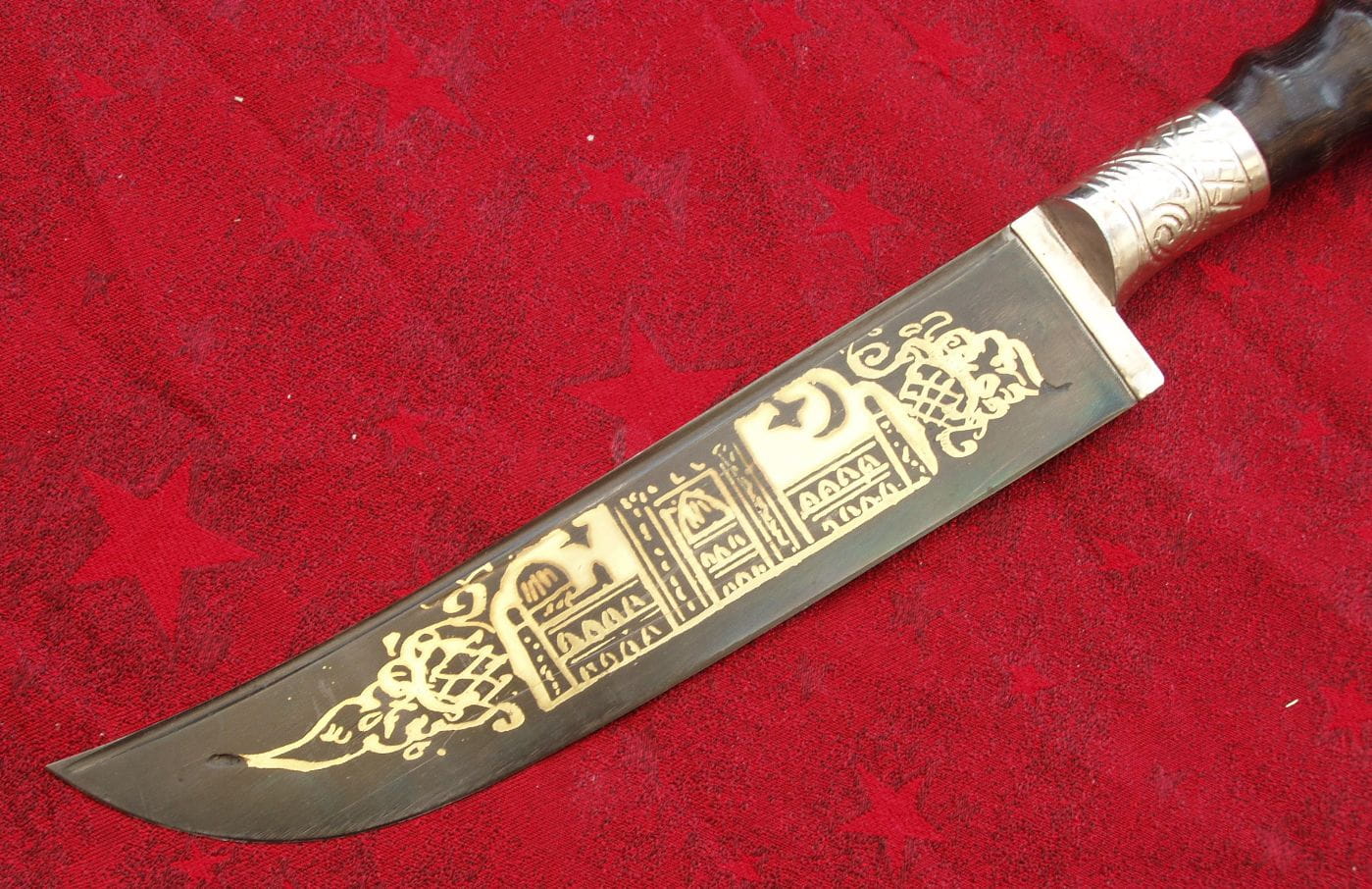
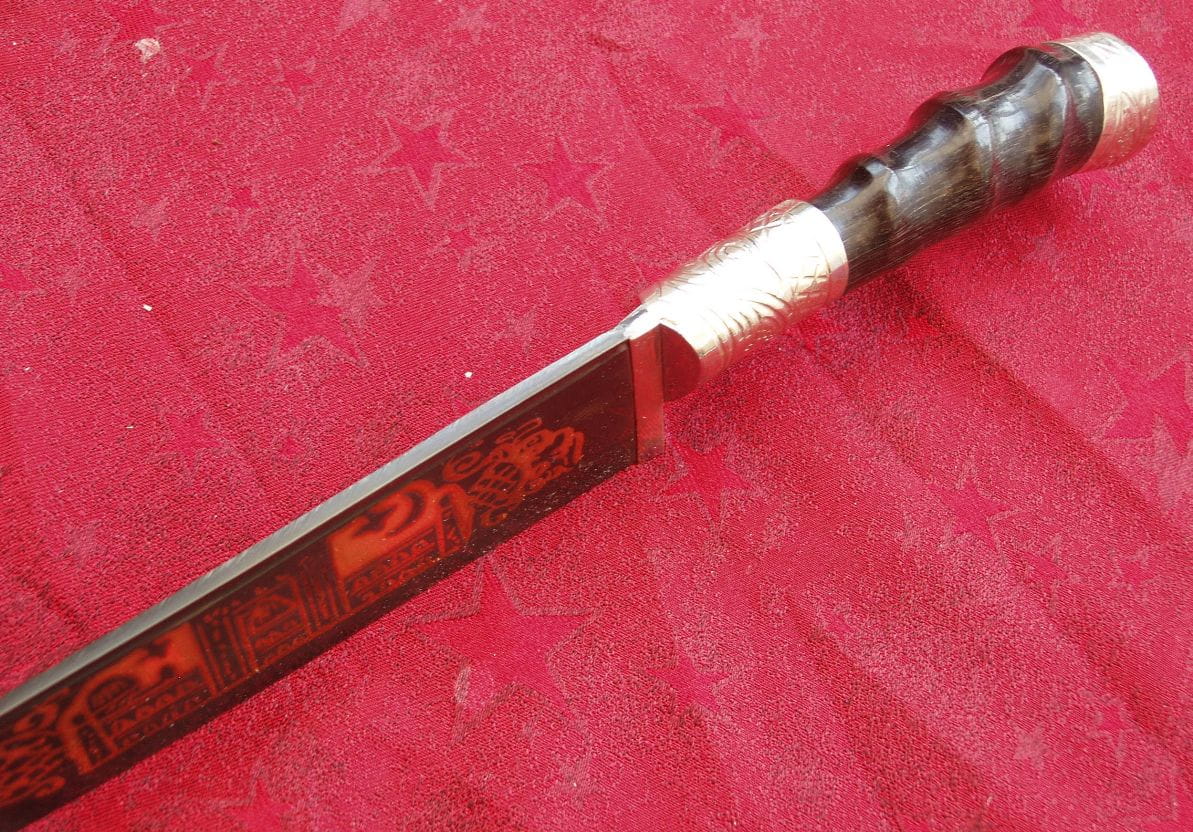
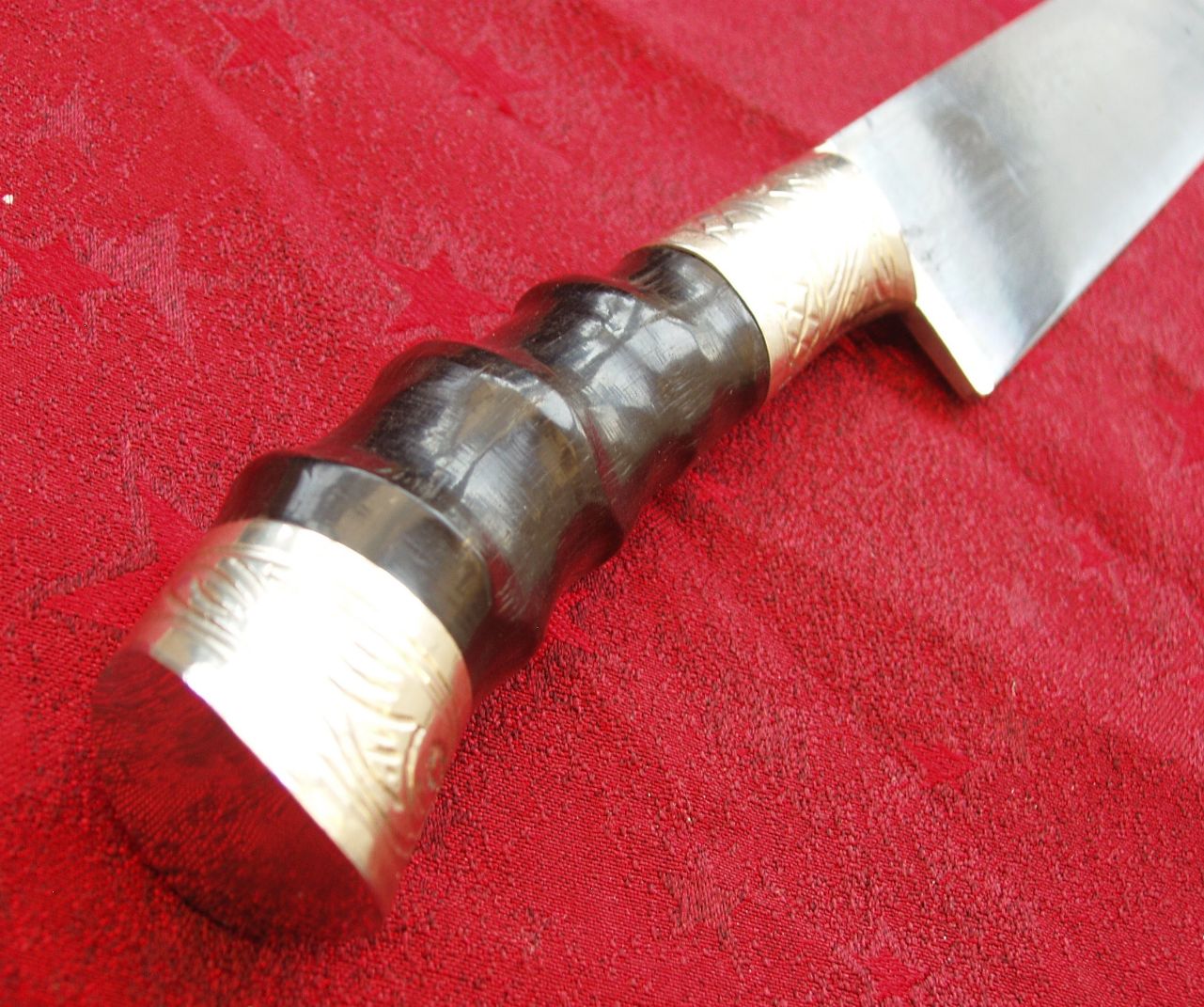
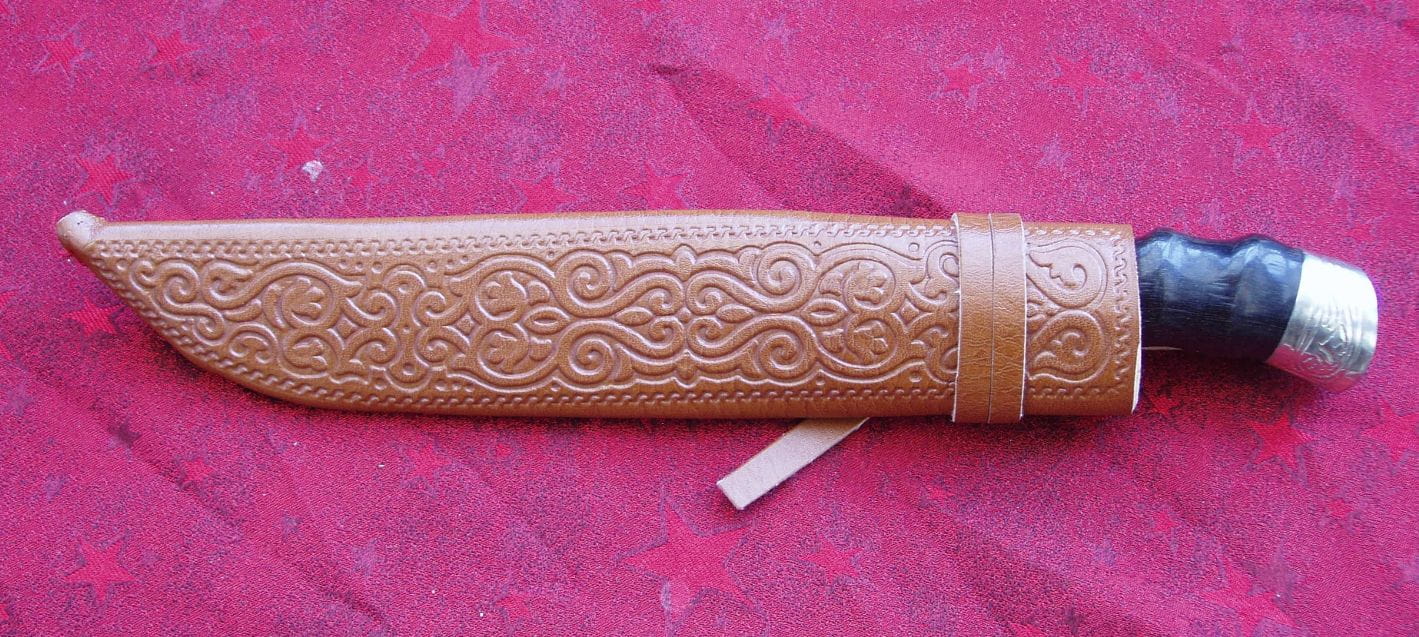
This pchak belongs to the typekajke –the tip of the blade is raised above the spine line. The blade is decorated on one side using the same method as the so-calledtamgi– symbols of a specific craftsman, equivalents of hallmarks: first, a pattern is engraved on the blade, which is then filled with brass. The pattern used is a traditional Koranic decorative motif depicting a school –medrese. The handle is made of the horn of asaiga antelope(a species of antelope found in the lower Volga and Caspian region).Giulband (a bolster characteristic of pchaks) and the pommel are made of nickel silver.The sheath, of a traditional form for knives from this region, is made of artificial leather with a plastic insert and decorative embossing. The blade has a dark gray hue typical of pchaks; this effect was once achieved by subjecting the blade to the action of clay with a special chemical composition. I can't say for sure if the same method is used today.
Overall length: 277 mm
Blade length: 160 mm
Blade width (max.): 38 mm
Blade thickness (max.): 3.3 mm
Steel (according to Russian nomenclature): ШХ15

 Briefly about pchaks (or pichaks, or pichoqs)