

- Knife sharpening(22)
- Portable wood-fired tandoor ovens(4)
- Books(11)
- Holsters(23)
- Gloves(13)
- Items made from animal horn(6)
- Protective gear(8)
- Sheaths, mounting systems, lanyards(9)
- Tourism - camping - survival(20)
- Posters(11)
- Knives(1642)
- Mosaic damascus, layered damascus, laminated blades(30)
- 1.4116 steel(13)
- Sleipner steel(8)
- Damascus type steel(328)
- AUS10, AUS10Co steel(30)
- 9XC steel(9)
- 14C28N steel(9)
- K110 steel(13)
- R12 steel(11)
- CPM S35VN steel(1)
- Bulat knives(36)
- 1095 steel(2)
- N690 steel(30)
- Х12МФ and D2 steel(206)
- Z90 steel(0)
- Pchak type knives(27)
- M398 steel(1)
- K340 steel(12)
- 95x18 steel(109)
- VG10 steel(17)
- M390 steel(3)
- NCV1 (80CrV2) steel(28)
- Push daggers(9)
- 65x13, AUS6, 420 steel(54)
- S390 steel(10)
- Yakut knives(8)
- Kitchen knives(7)
- Nessmuk knives(4)
- Skeleton and throwing knives(62)
- 65G steel(6)
- U8 steel(42)
- Z-160 steel(4)
- 50X14MF steel(13)
- Folding knives(250)
- Training knives(5)
- EI-107 and 100X13M steel(11)
- Peltonen knives (Peltonen finkas)(26)
- Vanadis 10 steel(6)
- Elmax steel(23)
- Nitro-V steel(0)
- AUS-8 steel(285)
- Neck knives(6)
- NKWD finka(15)
- Diving knives(3)
- Chinese stainless steels (7Cr17MoV, 8Cr13MoV, 5Cr15MoV)(69)
- PGK steel(16)
- WithArmour knives(6)
- XB5 steel(18)
- MV-58 steel(37)
- Niolox steel(5)
- 40X13 steel(4)
- Machetes, shovels, axes, tomahawks(59)
- Blades for knifemakers(172)
- Materials for knife handles(145)
- Military, survival, camouflage clothing(91)
- Bagdes(40)
- Holsters, pouches, tactical vests(73)
- Hunter belts, bags, canteens(9)
- Dog tags(22)
- Others(54)
Uygur Pchak 2 (silver, kosula horn)



Description
Pchak (from the Uzbek wordPichoq– knife) is a traditional knife of the Uzbeks and Uighurs, widespread with minor differences in detail throughout Central Asia. Pchaks traditionally have a single-edged blade with a full flat grind set in a narrow handle with a round cross-section. A narrow tang extends from the blade at the level of the spine. These are utility knives, for kitchen work, although among the Uighurs the pchak was an attribute of a man, so it also had to be used as a weapon. Pchaks were made from various materials; for the wealthy, these could be high-quality steels with richly decorated handles, but such specimens were rare. Boulat and Damascus steel were rather used for sabres, and mass-produced pchaks were made of low-hardness carbon steels. Today, Uzbek pchaks available in Russia are made in 90% from widely available industrial tool steel ШХ15 (Polish analogue LH15) hardened in the range of 40-45 HRC. ШХ15 is used for the production of rings, rolling bearings and other elements that require high hardness and abrasion resistance, operating in non-corrosive conditions. It is a great material for making knives, provided that it is not corrosion-resistant – after use, the knife must be wiped dry. Pchaks have excellent cutting properties.
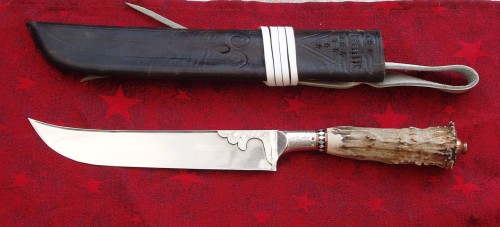
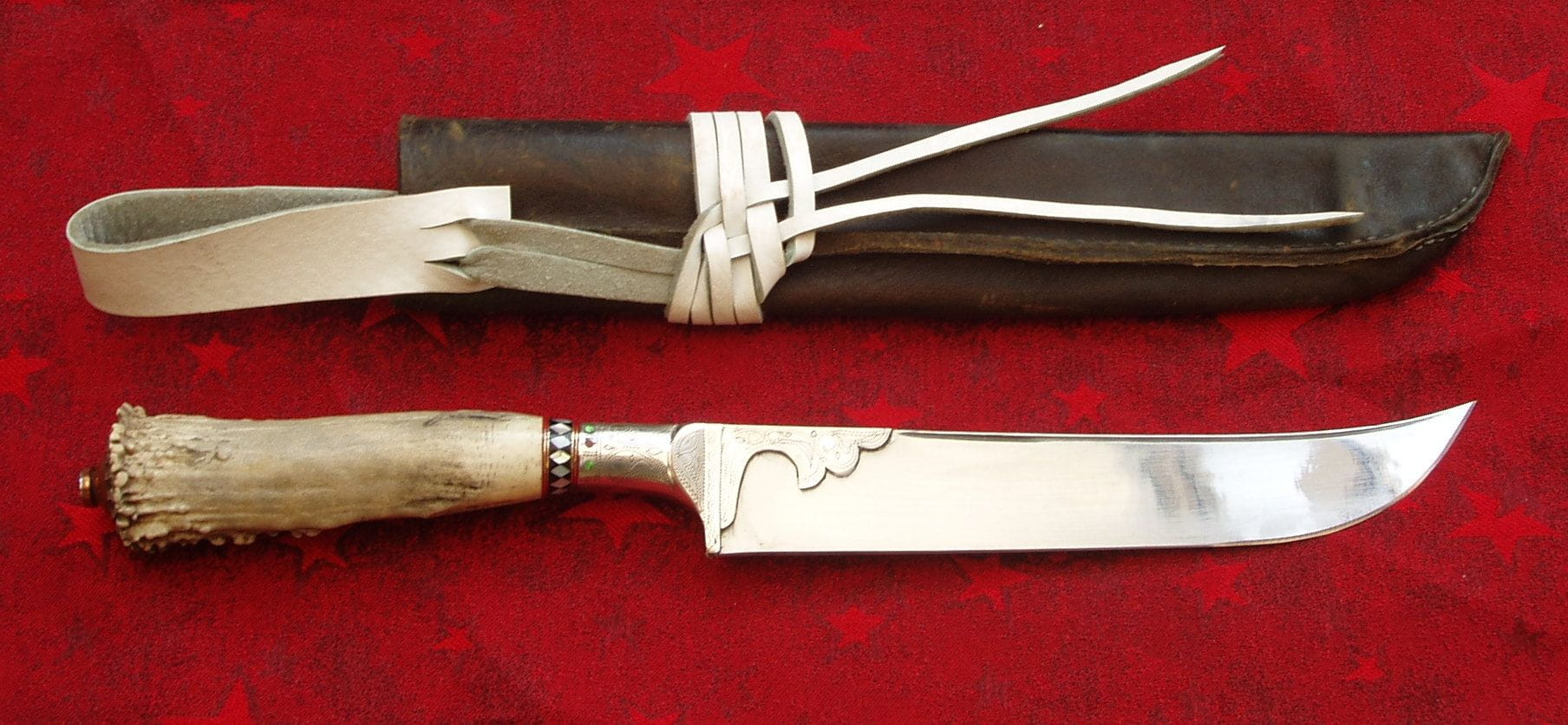
This pchak belongs to the typekajke –the tip of the blade is raised above the spine line. The handle is made kosula (roe deer) horn with giulband (bolster) and guard made of silver. The scabbard, in a traditional form for knives from this region, is made of artificial leather with a plastic insert and decorative embossing. The blade is smoothly ground, without a dark gray shade, with a narrow fuller running under the bolster.
Total length: 270 mm
Blade length: 155 mm
Blade width (max.): 25 mm
Blade thickness (max.): 3.8 mm
Steel (according to Russian nomenclature): ШХ15