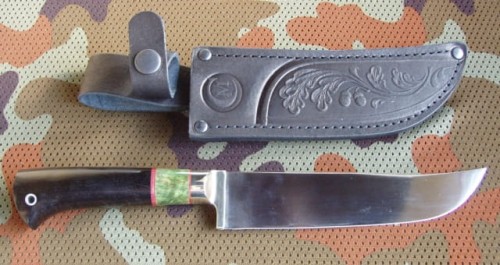
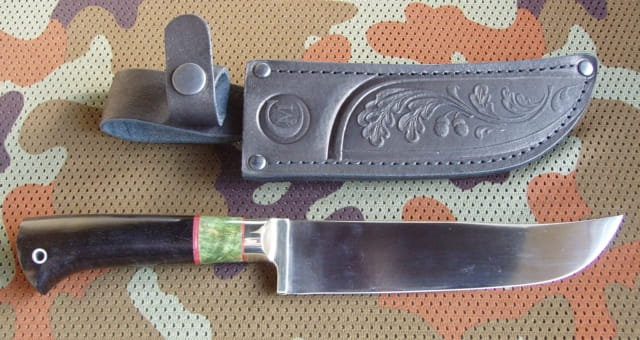
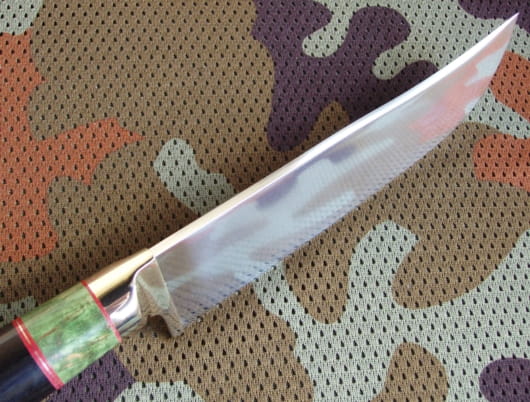
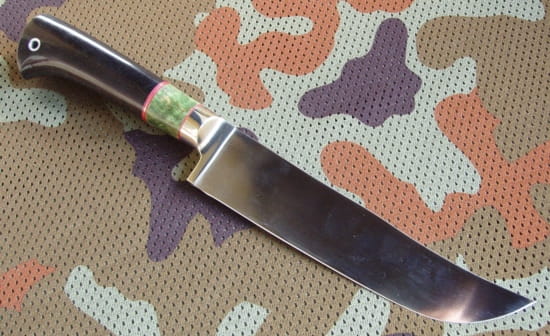
The Pchak (from the Uzbek word "Pichoq" – knife) is a traditional knife of the Uzbek and Uyghur people, widespread with minor variations throughout Central Asia. Pchaks traditionally feature a single-edged blade with a full flat grind, set in a narrow, round-cross-section handle. The narrow tang extends from the blade level with the spine. These are utility knives, intended for kitchen work, although among the Uyghurs, the Pchak was an attribute of a man, so it must have also been used as a weapon. Pchaks were made from various materials; for the wealthy, they could be crafted from high-quality steels with rich decorations, though such examples were rare. Wootz and Damascus steel were more commonly used for sabers, while mass-produced Pchaks were made from lower-hardness carbon steels. Today, 90% of Uzbek Pchaks available in Russia are made from the widely available industrial tool steel ШХ15 (Polish equivalent LH15). Pchaks offer excellent cutting performance. The Siomin company produces replicas of traditional Pchaks from more sophisticated materials, such as forge-welded Damascus and even powder steels.
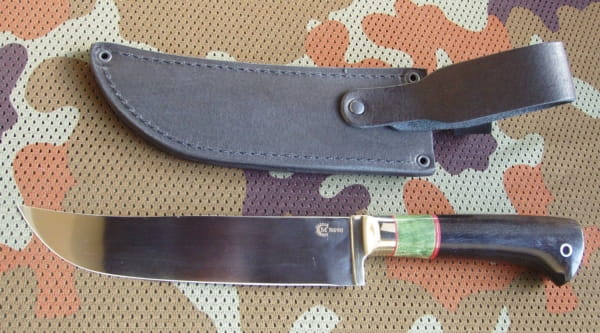
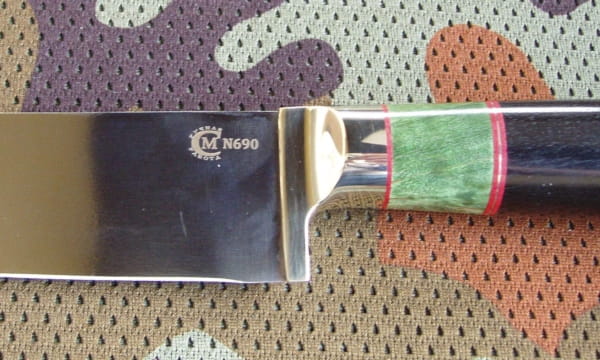
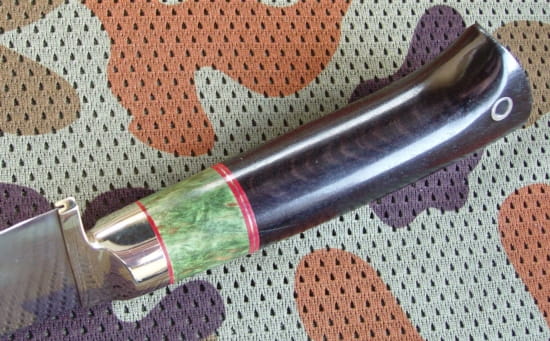
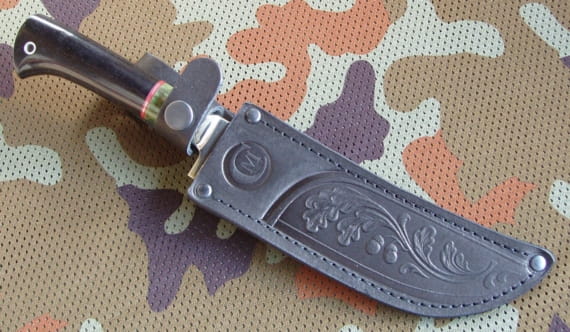
This particular Pchak, made from high-tech N690 powder steel by Bohler, belongs to the "kayke" type – the tip of the knife is raised above the spine line. The handle, with its traditional Pchak shape, is made of fine blackwood with an insert of stabilized Karelian birch and a brass bolster. The sheath, as with most of Siomin's products, is made of leather. Medium-sized Pchaks come with smooth sheaths, while large ones feature an embossed decorative pattern.
Overall length: 283 mm
Blade length: 159 mm
Blade width (max): 34 mm
Blade thickness (max): 4 mm
Steel: N690

 Briefly about pchaks (or pichaks, or pichoqs)